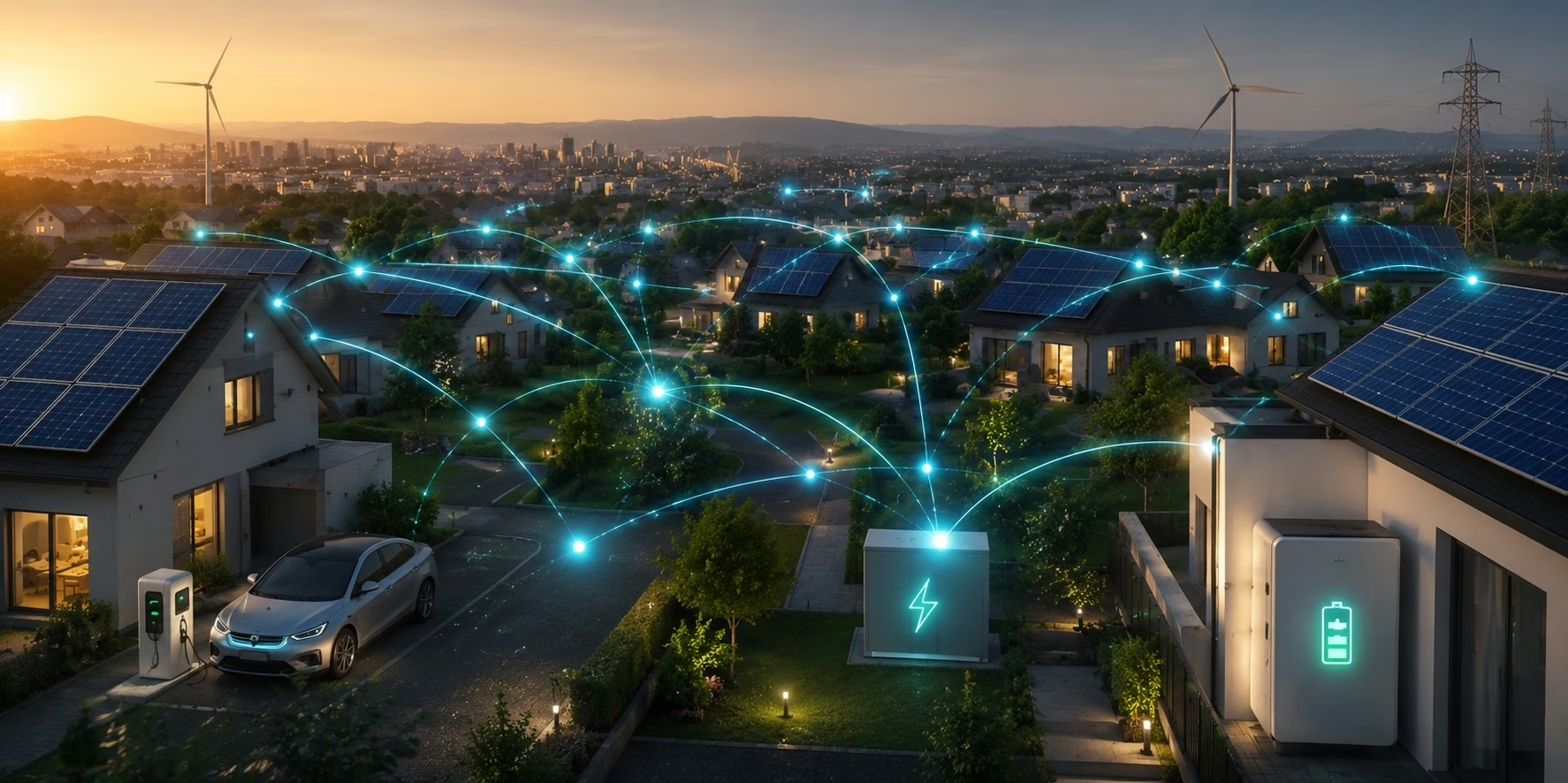
For more than a century, electricity systems were built around power plants. Consumers had one role: pay the bill. That model is starting to change. Millions of households equipped with rooftop solar, batteries and electric vehicles are becoming a new energy resource – helping balance the grid and earning money in return. According to Jan Hicl, Co-founder and Chief Product Officer at Delta Green, Europe’s largest battery may one day be not a single facility, but “millions of home batteries and electric cars acting as one”. After all, he notes, “we already have more storage capacity parked in EVs across Europe than in all grid-scale batteries combined”.
In an interview with NewsEnergy, Hicl explains why flexibility is becoming one of the most valuable resources in the energy transition, how households can earn money from supporting the grid, and why the future energy system may be built around people rather than power plants.
Learning to Live with the Breath of Nature
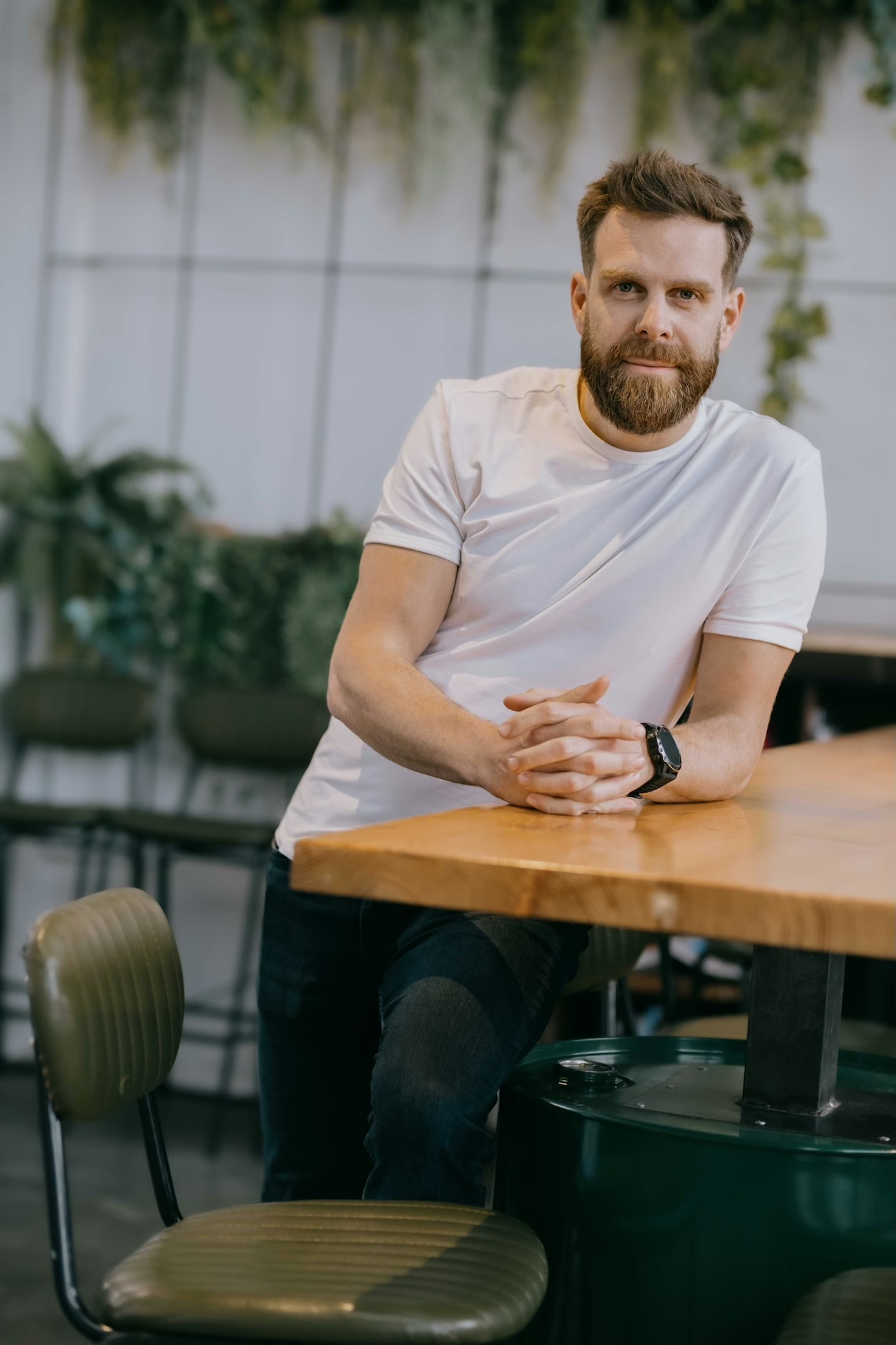
Jan Hicl, Co-founder and Chief Product Officer at Delta Green
NewsEnergy: Flexibility has become one of the hottest topics in Europe’s energy transition. For readers who are hearing this term for the first time, what exactly is flexibility and why does it matter?
Jan Hicl: Flexibility is the ability to move a household’s production or consumption around in time – to shift when you generate or use electricity. That is really all it is: shifting in time.
A telling detail is that we still don’t even have a unit for flexibility. We know what it is, and we can measure it in several different ways, but there is no single agreed unit the way we have the kilowatt-hour for energy. To me that shows we are right at the very beginning of the flexibility era.
Why does it matter? Because we, as a society, decided to build more and more renewables – and renewables are intermittent by nature, they produce on their own schedule, not ours.
In the old world it was the other way around: fossil-fuel power plants adjusted to our needs, ramping up and down to follow demand. Now the logic is reversed – we have to adjust to renewable generation. We sometimes describe it, almost poetically, as learning to live with the breath of nature.
NewsEnergy: You often say that Europe’s biggest untapped energy resource is not a power plant, but millions of households. What do you mean by that?
Jan Hicl: When people picture energy, they imagine a large power plant. But look at what is now sitting inside homes – solar panels on the roof, a battery in the garage, an electric car in the driveway, a heat pump or air condition on the wall. Individually each one is small. Added together across millions of homes, they represent more controllable capacity than several large power stations.
The problem until now is that this capacity was invisible and uncoordinated. Our job is to connect those assets so that millions of small decisions – charge now, wait an hour, store this energy – add up to something the grid can actually rely on. That is the resource hiding in plain sight.
A power plant that has no chimney and no turbine
NewsEnergy: Europe is rapidly adding solar and wind power. Why aren’t renewables alone enough, and why does the system need much more flexibility in the years ahead?
Jan Hicl: Solar and wind are wonderful, but they produce power when nature decides, not when we need it as it was with fossil powerplants. The sun does not shine on demand and the wind does not blow on schedule. As we add more of them, the gap between when energy is produced and when it is consumed grows wider. Without something to bridge that gap, you get surplus power wasted on sunny afternoons and shortfalls on still winter evenings.
Flexibility is that bridge. It lets us soak up cheap, clean energy when it is abundant and reduce or shift demand when it is scarce. So the more renewables we build, the more flexibility we need alongside them – they are two halves of the same system.
NewsEnergy: Studies suggest that demand-side flexibility could generate hundreds of billions of euros in benefits across Europe. Why is flexibility often cheaper than building new power plants, storage facilities or grid infrastructure?
Jan Hicl: Because it uses what already exists instead of building something new. If you can shave the few hours a year when demand truly peaks, you avoid power plants and grid reinforcement that would otherwise sit idle most of the time. A new peaking plant or a new line is enormously expensive and slow to permit and build. Coordinating millions of existing devices is software, and it scales almost instantly. So instead of pouring concrete for a problem that lasts a hundred hours a year, you solve it digitally. The cheapest megawatt is always the one you did not have to build – and that is where the hundreds of billions in system-wide savings come from.
NewsEnergy: Delta Green connects thousands of homes into what is known as a Virtual Power Plant. How does a virtual power plant work, and why can it be as valuable to the grid as a conventional power station?
A virtual power plant has no chimney and no turbine. It is software that connects thousands of small, distributed assets – batteries, EV chargers, solar inverters – and coordinates them as if they were one larger unit.
Jan Hicl: When the grid operator needs more or less power, our platform responds in seconds by adjusting those thousands of devices very slightly and simultaneously. The household barely notices. But to the grid, the combined response looks exactly like a conventional power plant turning up or down. The difference is that ours is built from assets that already exist, responds faster, and is cleaner. That is why a well-run virtual power plant can be just as valuable to grid stability as a physical one.
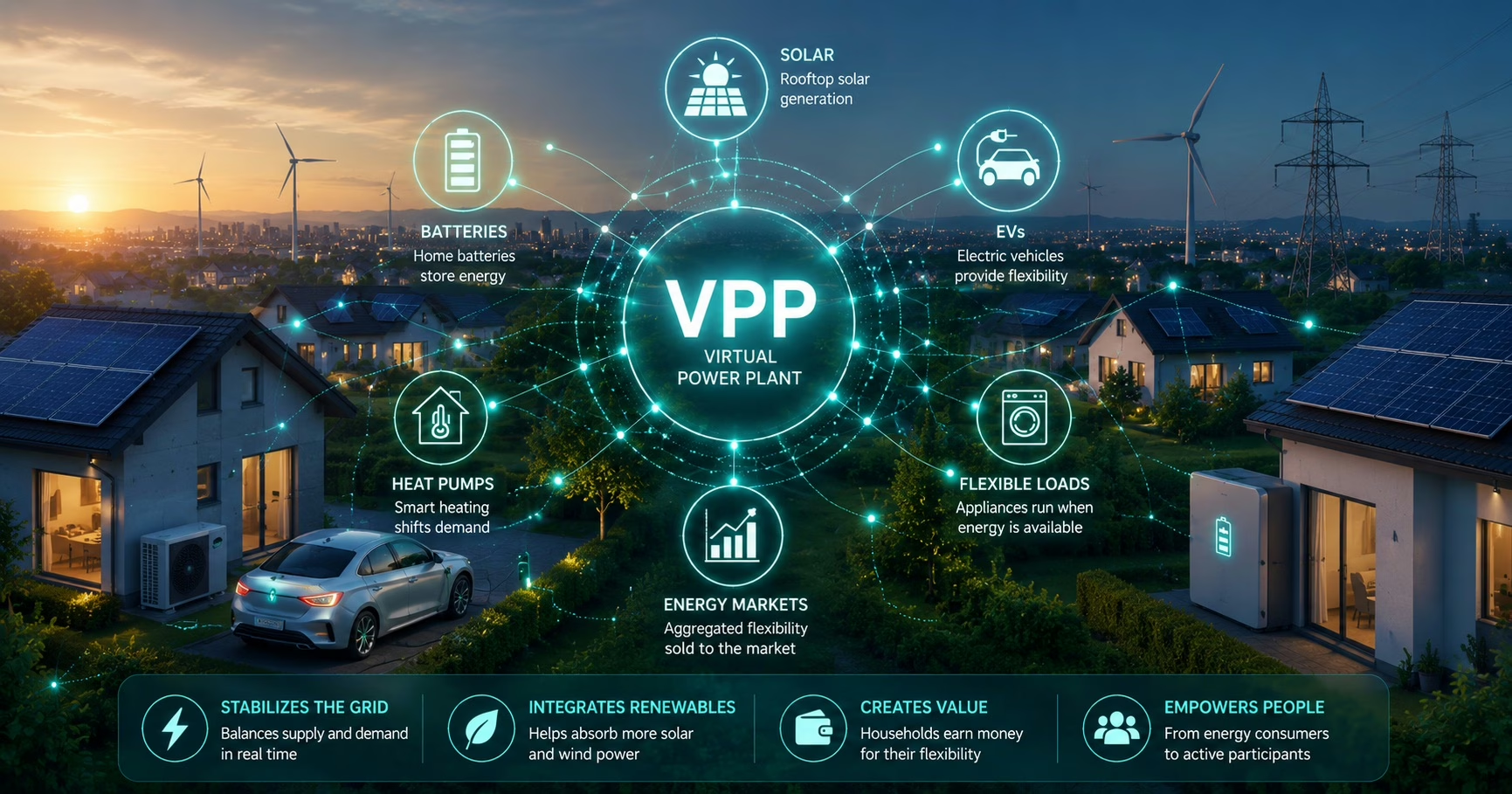
Virtual Power Plant concept – *AI generated image (source: NewsEnergy)
The Business Case for Flexibility
NewsEnergy: Let’s take a practical example. Imagine a family with rooftop solar panels, a battery and an electric vehicle. How can that household help balance the grid?
Jan Hicl: Take a family that comes home in the evening and plugs in the car. Left alone, everyone charges at the same moment, exactly when demand already peaks. Through our platform, that car can charge a little later or more slowly when the grid is under less strain – without the family ever waking up to an empty battery. Their home battery can store cheap solar energy at midday and feed the house in the evening instead of drawing from the grid. And at moments when the system is short of power, the battery can even push a little energy back.
None of this requires the family to change their daily life. The software makes thousands of these tiny, intelligent decisions on their behalf.
NewsEnergy: Many people will immediately ask: „What’s in it for me?” How can households actually earn money from flexibility services?
Jan Hicl: This is the right question to ask, and the honest answer is – real money, with no change to your comfort. When a household lets its assets help balance the grid, the value created by that service flows back to them. It happens in a couple of ways: lower energy costs by using power when it is cheapest, and direct rewards for making flexibility available when the grid needs it.
The key point is that the household is being paid for something they were already doing – owning a battery, an EV or solar – just done a little more intelligently.
We handle all the complexity in the background. The customer keeps a fully charged car, a warm home, and earns money on top.
Romania’s Opportunity
NewsEnergy: In the Czech Republic, some customers can earn up to €200 per year. What’s the potential income for a Romanian household? Where does that value come from and who is paying for it?
Jan Hicl: In the Czech market a household can earn up to around €200 per year today, and that figure tends to grow as more value streams open up. For a Romanian household the potential is comparable – and arguably stronger over time, because Romania is electrifying quickly and its prosumer base is expanding fast. The exact number depends on what assets the home has and how the local market develops, so I would be cautious about quoting a single figure yet.
As for where the value comes from – it is not a subsidy. It is real value created by helping the grid avoid expensive interventions: balancing power, relieving congestion, avoiding new peak capacity. The grid operator and the wider electricity market pay for that service, and we pass the majority of it back to the household.
NewsEnergy: Romania already has one of the fastest-growing prosumer markets in Europe. What needs to happen for Romanian households to start benefiting from flexibility in the same way as customers in more advanced markets?
Jan Hicl: A few things need to come together – and the encouraging part is that they already are. Flexibility reaches households through their energy supplier, so the real question is how quickly Romania’s leading retailers adopt it and roll it out to their customers. That is exactly where the market is heading.
We work hand in hand with major energy retailers across Europe, and in Romania we are partnering with Premier Energy – in my view the most innovative player on the Romanian market right now. They are pursuing this opportunity very seriously and plan to bring the product to their customers by the end of this year.
The other piece is that Romania already has the hardest ingredient in place: a large and fast-growing base of prosumers with solar and batteries. So you have the customer base, an ambitious retailer ready to deliver the service, and the technology to make participation simple for households. Once those three meet at scale – and that is happening now – Romanian households can start benefiting just as customers in more advanced markets already do.
The Home as a Power Plant
NewsEnergy: Today we talk a lot about prosumers. Tomorrow we may talk about virtual power plants, energy communities and peer-to-peer energy trading. How do you see the role of households evolving over the next decade?
Jan Hicl: Today most households are passive consumers who simply receive a bill. Over the next decade I think that relationship inverts. Households become active participants – producing, storing and trading energy. We will see energy communities where neighbours share locally produced power, and eventually peer-to-peer arrangements where you might buy your neighbour’s surplus solar directly.
The home stops being just a point of consumption and becomes a small power station, a battery and a trader all at once. Much of the technology to do this already exists. What is evolving is the market design – and the public’s understanding that their home is now an asset, not just an expense.
NewsEnergy: If we were having this conversation ten years from now, what would Europe’s energy system look like if your vision succeeds? Could Europe’s largest battery really be made up of millions of homes?
Jan Hicl: If the vision succeeds, Europe’s energy system looks far more decentralised and far more resilient. Instead of a handful of giant plants, you have millions of coordinated homes, vehicles and batteries acting together.
And yes – I genuinely believe Europe’s largest battery will not be a single facility, it will be millions of home batteries and electric cars acting as one. We already have more storage capacity parked in EVs across Europe than in all grid-scale batteries combined.
The question was never whether the capacity exists – it was whether we could coordinate it intelligently. That is the problem we are solving, and ten years from now I expect this to feel completely normal.
NewsEnergy: For more than a century, energy systems have been built around power plants. Do you think the next generation of energy infrastructure will be built around people instead?
Jan Hicl: Yes, and I think it is one of the most profound shifts in the history of the energy system. For over a century the model was top-down – a few large plants generating power and pushing it out to passive consumers. The next generation is bottom-up: energy generated, stored and managed close to where it is used, by the people who use it. That does not mean power plants disappear – we will still need them. But the centre of gravity moves. The system gets built around people and their assets, rather than treating them as the end of a wire. It is a more democratic, more participatory energy system.
The Uberisation of Energy
NewsEnergy: Today, Delta Green aggregates households into virtual power plants. Is that the final destination, or just an intermediate step towards a future where households can trade energy and flexibility through digital platforms, much like drivers and homeowners use Uber or Airbnb today?
Jan Hicl: Aggregation into virtual power plants is a crucial step, but it is not the final destination – think of it as building the rails. Once millions of homes are connected and able to act intelligently, the natural next step is to let value flow more directly between them, which is exactly the Uber and Airbnb analogy. Today we coordinate assets on behalf of households and the grid. Tomorrow those same households could trade flexibility and energy with each other through a digital platform, with us providing the trust, the technology and the market access underneath. So aggregation is the foundation. The platform economy for energy is what gets built on top of it.
***
Jan Hicl Short Bio

Jan Hicl, Co-founder and Chief Product Officer at Delta Green
Jan Hicl is Co-founder and Chief Product Officer at Delta Green Europe, a B2B SaaS (Software as a Service) company enabling energy suppliers to aggregate residential flexibility, home batteries, EVs, heat pumps, and actively participate in grid balancing.
Before Delta Green, Jan spent nearly five years at Socialbakers, progressing from Product Owner to Director of Product Management, where he led a team that defined the product vision and strategy for over 2,500 clients worldwide. He went on to co-found InstaCover.ai and S9Y, developing tech products at the intersection of automation and data.
At Delta Green, Jan brings this depth of SaaS product experience to one of the energy sector’s most complex challenges: making the integration between household energy assets and wholesale energy markets seamless, commercially viable, and scalable. His focus is on building a platform that gives energy suppliers a real competitive advantage, without requiring them to build the technology themselves.
With a foundation in AI-driven automation and data analytics, Jan is motivated by a clear goal: smarter, more flexible energy systems ready for the renewable transition.
About Delta Green
Delta Green is a Czech energy technology company that empowers households to use electricity efficiently and responsibly. Beyond energy supply, it offers intelligent, automated solutions for managing electricity consumption and production, aggregating residential flexibility assets into a Virtual Power Plant for energy suppliers.
Delta Green was the first company to provide 100% green electricity in the Czech Republic.
Renewable sources like wind and solar are essential, but intermittent. Grid balancing has historically relied on coal, an approach that is unsustainable. Delta Green aggregates everyday household assets: shifting consumption patterns, smoothing demand peaks, and keeping the grid stable through software, not combustion.
Originally established in 2008 as Nano Green under the Nano Energies group, the company rebranded as Delta Green in 2024. It is jointly owned by David Brožík, Prokop Čech, Lukáš Beneš, and Jan Hicl.
READ ALSO:
Op-ed // The moonshot moment for energy communities: expectations from the Citizens Energy Package
Europe has the tech. So why isn’t it a renewable superpower yet?
Empowering the next generation: Youth engagement as a pillar of the Energy Transition